Thursday, January 11, 2007


Friday, October 27, 2006
Our friend Mario finally awarded asylum!

Congratulations Mario! Good news in a world full of bad.
Estudiante salvadoreño de UCLA obtiene asilo político
Mario Escobar afirma estar feliz de quedarse en Estados Unidos
Jorge Morales Almada
jorge.morales@laopinion.com
27 de octubre de 2006
Mario Escobar, un ex militante de la guerrilla salvadoreña que llegó indocumentado a este país hace 15 años y que hoy es un destacado estudiante a punto de graduarse en la Universidad de California en Los Ángeles (UCLA), recibió ayer el asilo político por un juez de inmigración.
"Alegre, me siento alegre, porque validaron todo lo que viví en El Salvador", dijo Mario al salir del tribunal de inmigración en el centro de Los Ángeles, aún con los ojos rojos de llanto.
Y es que adentro en el tribunal, cuando el juez William Martin Jr. le dijo que le concedía el asilo, Mario se estremeció, se quitó los lentes, restregó sus ojos con los puños, y se soltó llorando, luego volteó a ver a su esposa y le echó una mirada de esperanza.
No era para menos, ya que en este país no es fácil ganar un caso de asilo político cuando el solicitante es salvadoreño.
Un reciente estudiohttp://www.blogger.com/img/gl.link.gif, que analizó 300 mil casos entre 1994 y 2005, elaborado por la organización Transactional Records Access Clearinghouse (TRAC), de la Universidad de Syracuse, en Nueva York, revela que el 80% de las peticiones de asilo son rechazadas cuando el solicitante es de El Salvador.
Mario comentó, luego de agradecer al juez su decisión, que su estancia legal en el país representa una oportunidad para poder luchar por otros estudiantes.
"Para continuar la lucha, para luchar por estudiantes igual que yo, porque creo que los jóvenes están pasando por mucho y algo se tiene que hacer, estudiantes que quieren continuar su carrera y que no pueden, madres de familia que están siendo separadas de sus esposos e hijos, que están siendo deportados, hay que luchar", dijo en las escalinatas del edificio federal.
Para este joven de 28 años la decisión del juez le da validez a todas las personas que han sufrido a causa de la guerra civil en su país, donde su padre fue asesinado cuando él era un niño.
READ MORE
Tuesday, October 10, 2006
Columbus and Guatemala
Exploring Christopher Columbus Day
By Elias Lawless, WireTap. Posted October 9, 2006.
Today, youth across the nation are told by our government that Christopher Columbus merits honor and celebration.
Historically, recognition of Columbus Day has reflected a bipartisan consensus: It was Democrat Franklin Roosevelt who first suggested in 1934 that all states adopt Oct. 12 as Columbus Day; in 1971, under Republican Richard Nixon, the second Monday of October officially became established as a federal holiday to honor the explorer.
To "discover" more about the man behind the day off (not to mention the namesake for our nation's capital, the District of Columbia), last year, on the eve of the nationwide break from school, I headed to my university library to learn about Christopher Columbus and the days following Oct. 12, 1492.
My findings were horrific:
* Two days following Columbus' arrival in the Bahamas, he recorded in his personal log, "These people are very unskilled in arms … with 50 men they could all be subjected and made to do all that one wished." This first impression would prove ominous.
* In November 1493, on a return trip to Hispaniola, Columbus ordered the enslavement of six indigenous women for the purpose of allowing his crew to rape them.
* In February 1495, Columbus rounded up 1,500 Arawak women, men and children, and imprisoned them. He then selected the 500 of them that he deemed the most marketable and shipped them to Spain. Only 300 arrived alive in Seville.
* In 1498, documents indicate that Columbus enslaved another 600 Carib people.
* By the decade's end, it appears that Columbus had kidnapped at least 1,400 indigenous people to send back to the Spanish slave markets.
Additionally, Harvard historian and Pulitzer Prize laureate Samuel Eliot Morison writes, "The cruel policy initiated by Columbus and pursued by his successors resulted in complete genocide," and "the natives were reduced to a species of slavery or serfdom and declined in numbers catastrophically."
Given the realities of Columbus' campaigns of mass murder and enslavement, why do we commemorate this man ever, much less every year?
It is clear that we are not lauding his skills as a sailor, considering that history teaches us his so-called "discovery" was purely accidental. What do we care that some man from Genoa sailing on behalf of Spain landed in the already inhabited Bahamas? And how does that involve ordinary students within the United States, who overwhelmingly speak English as their primary language (and not Spanish nor Italian)?
Perhaps if Columbus Day were a somber, yearly reminder of our nation's origins, which spurred us to reflect upon our responsibility to undo these oppressive traditions, the day would be beneficial. But as it stands, by seemingly rewarding youth with a day off from school to praise the man who in many ways initiated and still embodies the mass murder of indigenous peoples, Columbus Day instead serves to reinforce these abhorrent crimes.
If we cannot recognize enormous acts of brutality committed half a millennium ago, (but, in fact, actually celebrate their chief perpetrator) then what implications does this carry for acts of brutality committed more recently?
One week after Columbus Day, elections within the United Nations will determine Argentina's replacement for the Latin American seat on the Security Council -- and the United States' current lobbying campaign may yield some sort of indication.
Rather than admonish Guatemala for failing to prosecute its past dictators and military brass for upwards of 600 massacres committed against the indigenous Maya, the United States is pushing hard for Guatemala's appointment to the Security Council. Their efforts have paid off, as many in the European Union and Central America appear to have been won over by the superpower's diverse means of persuasion.
It seems that for the United States government, publicly esteeming those who carried out, or continue to leave unpunished, a heinous genocide (many of whom remain remarkably powerful within the Guatemalan state), encompasses more than a once-a-year affair.
But can the United States' annual lauding of Columbus really be plausibly linked to its cheerleading for Guatemala? Ward Churchill, an educator at the University of Colorado, argues:
"Very high on the list of those expressions of nonindigenous sensibility which contribute to the perpetuation of genocidal policies against Indians are the annual Columbus Day celebration, events in which it is boldly asserted that the process, events, and circumstances described above are, at best, either acceptable or unimportant. … Undeniably, the situation of American Indians will not -- in fact cannot -- change for the better so long as such attitudes are deemed socially acceptable by the mainstream populace. Hence, such celebrations as Columbus Day must be stopped."
Venezuela, Guatemala's competitor for the Security Council spot, decided in 2002 to do just that -- transforming Columbus Day into el Dìa de Resistencia Indigena or Indigenous Resistance Day, to instead celebrate native peoples and "the spirit of dialogue between civilizations, peace and justice." Interestingly, Venezuela's principal pitch for its bid at the Security Council is to counteract what many view as the imperialist tendencies of the United States (those tendencies exemplified in Columbus, the hemisphere's pioneering imperialist).
Meanwhile, one must seriously question Guatemala's suitability for the Security Council given its troubles with, well, security. Following a visit three months ago, Louise Arbour, the U.N. High Commissioner for Human Rights, labeled Guatemala as "one of the most violent countries in the region … where impunity is the rule for past violations, it should come as no surprise that it also prevails for current crimes." Indeed, Le Monde Diplomatique reports that an estimated 97 percent of all current murders within Guatemala go unpunished. Not so comforting for a nation that boasted around 15 murders a day last year, a rate that appears to be on the rise this year.
Granted, the United States sees in Guatemala a lackey that will vote as the United States dictates throughout its two-year tenure on the Security Council. Fears of Venezuela aside, how can the Bush administration overlook both Guatemala's glaring lack of qualifications for the job, and, more specifically, the repulsive reality of a recent, still-unpunished genocide?
Today, a major piece to that answer may float festively down the streets of New York City, imbedded in mobs of cheering spectators, famous faces and inflated cartoon celebrities -- televised globally to millions but contemplated, much less mentioned out loud, by very few.
Elias Lawless currently lives in Guatemala.
By Elias Lawless, WireTap. Posted October 9, 2006.
Today, youth across the nation are told by our government that Christopher Columbus merits honor and celebration.
Historically, recognition of Columbus Day has reflected a bipartisan consensus: It was Democrat Franklin Roosevelt who first suggested in 1934 that all states adopt Oct. 12 as Columbus Day; in 1971, under Republican Richard Nixon, the second Monday of October officially became established as a federal holiday to honor the explorer.
To "discover" more about the man behind the day off (not to mention the namesake for our nation's capital, the District of Columbia), last year, on the eve of the nationwide break from school, I headed to my university library to learn about Christopher Columbus and the days following Oct. 12, 1492.
My findings were horrific:
* Two days following Columbus' arrival in the Bahamas, he recorded in his personal log, "These people are very unskilled in arms … with 50 men they could all be subjected and made to do all that one wished." This first impression would prove ominous.
* In November 1493, on a return trip to Hispaniola, Columbus ordered the enslavement of six indigenous women for the purpose of allowing his crew to rape them.
* In February 1495, Columbus rounded up 1,500 Arawak women, men and children, and imprisoned them. He then selected the 500 of them that he deemed the most marketable and shipped them to Spain. Only 300 arrived alive in Seville.
* In 1498, documents indicate that Columbus enslaved another 600 Carib people.
* By the decade's end, it appears that Columbus had kidnapped at least 1,400 indigenous people to send back to the Spanish slave markets.
Additionally, Harvard historian and Pulitzer Prize laureate Samuel Eliot Morison writes, "The cruel policy initiated by Columbus and pursued by his successors resulted in complete genocide," and "the natives were reduced to a species of slavery or serfdom and declined in numbers catastrophically."
Given the realities of Columbus' campaigns of mass murder and enslavement, why do we commemorate this man ever, much less every year?
It is clear that we are not lauding his skills as a sailor, considering that history teaches us his so-called "discovery" was purely accidental. What do we care that some man from Genoa sailing on behalf of Spain landed in the already inhabited Bahamas? And how does that involve ordinary students within the United States, who overwhelmingly speak English as their primary language (and not Spanish nor Italian)?
Perhaps if Columbus Day were a somber, yearly reminder of our nation's origins, which spurred us to reflect upon our responsibility to undo these oppressive traditions, the day would be beneficial. But as it stands, by seemingly rewarding youth with a day off from school to praise the man who in many ways initiated and still embodies the mass murder of indigenous peoples, Columbus Day instead serves to reinforce these abhorrent crimes.
If we cannot recognize enormous acts of brutality committed half a millennium ago, (but, in fact, actually celebrate their chief perpetrator) then what implications does this carry for acts of brutality committed more recently?
One week after Columbus Day, elections within the United Nations will determine Argentina's replacement for the Latin American seat on the Security Council -- and the United States' current lobbying campaign may yield some sort of indication.
Rather than admonish Guatemala for failing to prosecute its past dictators and military brass for upwards of 600 massacres committed against the indigenous Maya, the United States is pushing hard for Guatemala's appointment to the Security Council. Their efforts have paid off, as many in the European Union and Central America appear to have been won over by the superpower's diverse means of persuasion.
It seems that for the United States government, publicly esteeming those who carried out, or continue to leave unpunished, a heinous genocide (many of whom remain remarkably powerful within the Guatemalan state), encompasses more than a once-a-year affair.
But can the United States' annual lauding of Columbus really be plausibly linked to its cheerleading for Guatemala? Ward Churchill, an educator at the University of Colorado, argues:
"Very high on the list of those expressions of nonindigenous sensibility which contribute to the perpetuation of genocidal policies against Indians are the annual Columbus Day celebration, events in which it is boldly asserted that the process, events, and circumstances described above are, at best, either acceptable or unimportant. … Undeniably, the situation of American Indians will not -- in fact cannot -- change for the better so long as such attitudes are deemed socially acceptable by the mainstream populace. Hence, such celebrations as Columbus Day must be stopped."
Venezuela, Guatemala's competitor for the Security Council spot, decided in 2002 to do just that -- transforming Columbus Day into el Dìa de Resistencia Indigena or Indigenous Resistance Day, to instead celebrate native peoples and "the spirit of dialogue between civilizations, peace and justice." Interestingly, Venezuela's principal pitch for its bid at the Security Council is to counteract what many view as the imperialist tendencies of the United States (those tendencies exemplified in Columbus, the hemisphere's pioneering imperialist).
Meanwhile, one must seriously question Guatemala's suitability for the Security Council given its troubles with, well, security. Following a visit three months ago, Louise Arbour, the U.N. High Commissioner for Human Rights, labeled Guatemala as "one of the most violent countries in the region … where impunity is the rule for past violations, it should come as no surprise that it also prevails for current crimes." Indeed, Le Monde Diplomatique reports that an estimated 97 percent of all current murders within Guatemala go unpunished. Not so comforting for a nation that boasted around 15 murders a day last year, a rate that appears to be on the rise this year.
Granted, the United States sees in Guatemala a lackey that will vote as the United States dictates throughout its two-year tenure on the Security Council. Fears of Venezuela aside, how can the Bush administration overlook both Guatemala's glaring lack of qualifications for the job, and, more specifically, the repulsive reality of a recent, still-unpunished genocide?
Today, a major piece to that answer may float festively down the streets of New York City, imbedded in mobs of cheering spectators, famous faces and inflated cartoon celebrities -- televised globally to millions but contemplated, much less mentioned out loud, by very few.
Elias Lawless currently lives in Guatemala.
Sunday, September 03, 2006

Communique from El Salvador
From Aryeh:
dear ones,
this posting would have been accompanied by lovely photos but my camera
mysteriously stopped working so hopefully my words will paint the
picture.
i have to warn you that sometimes, it ain´t pretty...
with all my love, aryeh
las montañas de morazán
2 de augusto de 2006
the first week of August is an official government vacation and thus i
decided to take advantage of the time to venture to Perquín, a small
village in the northern pine-encrusted mountains of El Salvador. I had
promised to myself that in this next phase of my work here, I would
take
more time off, leave the village and see more of the country to gain a
deeper understanding of its history, its popular movements and its
complexities, in addition to taking a little time for myself.
which is why i felt a bit betrayed by my body when the night before
leaving, i broke into a feverish sweat. i was determined to take these
rarely-encountered-consecutive-days-in-a-row off and so i rebelled and
boarded the bus anyway for Morazán.
on the ride north i began to take note, feverishly, dreamily, perhaps
deliriously, of the changes in the landscape. i´ve been living in
Usulután where the land is stretched flat, flat and more flat. i´m a
mountain creature at heart, which perhaps describes my instinctive move
from the flatlands of Michigan to the sierras and rolling hills of
California. my spirit quickened as the bus began to chug sluggishly
upward and the mountains began to rise and rise, stretching their
bodies
seductively upward toward the sky.
in my dreamy state i listened to the evalengical preacher who boarded
the
bus, working himself into a frenzy, spit flying, hailing the word of
God
to a captive though mostly dozing audience. When he was finished,
another
man began his passionate pitch to sell cheap medical remedies for
various
ailments which he described in full anatomical detail acompanied by
illustrative visual aids.
i finally got off the bus and sat by the side of the road, waiting for
the
pick-up for the last leg of the journey, while vendors came by to offer
me
everything from socks, tighty-whiteys and boxer shorts, to rat poison,
to
belts with tweetybird stamped on its buckle. i settled for a gatoraid,
hoping to replenish my dehydrated body with a few extra electrolytes.
the pick-up finally arrived and we were herded inside like cattle, both
sides lined with people sitting on benches, and those of us who had to
stand were strategically squashed into the space in order to fill the
camper to its optimal capacity. i found myself pressed back to back
with
an old man and for nearly half an hour, we supported each others weight
through the twists and turns of our ascent. we never exchanged names
or
life stories, but i felt a sweet human connection with him through our
simple act of sharing weight. when i was finally given a chance to
sit, i
turned my attention to the view available through the back of the tarp
covered pickup. my heart leapt as the tropical trees gave way to their
higher altitude brothers and sisters of pine, oak and buckeye.
i delighted in the sight of sunlit dewdrops quivering at the end of
pine
needles. i looked forward to walking for hours through those trees,
surrendering my soul to long vistas and silence. the air was brisker,
forcing me to reach into my backpack and pull out my hoodie which i
have
never worn, not even once, in the heat of the Bajo Lempa. when we
arrived,
I was quite weary from the journey and still feverish so I took refuge
in
the blue painted room of my lodge and began to reread ¨The Massacre of
El
Mozote¨ which took place here in December of 1981.
the Salvadoran government had initiated its new American-learned
Scorched
Earth policy, or Tierra Arrasada. another description for this was
¨quitarle el agua al pez¨ or ¨take the water away from the fish¨.
This
means that entire villages were systematically wiped out for being
¨geurilla sympathïzers¨. this policy intentionally included the killing
of
chilren in order to eliminate the potential risk of their becoming
¨future
guerillas¨.
the U.S. and Israeli governments seem to be harking back to scorched
earth policies in the Middle East. Take for example, the wholescale
destruction of the city and recent genocide of thousands of innocent
Iraqis to ¨liberate¨ Fallujah of insurgents, or now the systematic
bombing
of southern Lebanon and the genocide of Qana by U.S.-armed Israel, in
which all the men, women and children who remain are considered to be
Hezbollah or Hezbollah supporters, thus justifying the carnage.
Much of the genocide of today is committed by arial strike, whereas
this
massacre was committed machete to throat. when the Atlacatl Battalion
arrived, they assembled the entire population into the square. in the
morning, they proceeeded to interrogate, torture and execute the men.
around noon, they began taking the young girls out and raping them on
the
hillsides. in the late afternoon light, the women were separated from
their children, taken out in groups and machine-gunned to their deaths.
Finally, by the end of the day, they killed the children.
Rufina Amaya, who is the sole survivor of El Mozote, had escaped from
her
line and hid under the cover of a crab-apple tree. She has told her
story
many times, of having seen her husband decapitated by soldiers, of
hearing
the screams of the young girls being raped, of hearing her small boy
child
yelling ¨Mamá, they killed my sister! Mamá, Help me! They´re killing
me¨,
of having to dig a hole in the earth so that no one would hear her
crying.
when they finished the exterminations, they set fire to the homes,
killed
all the animals and left the bodies unburied, to serve as a message of
what would lie in store for other would-be guerilla sympathizers.
There have been 767 documented victims, failing further exhumations. my
guide to El Mozote, a wizened old ex-guerilla told me that this number
is
low, that there were so many more, well over 1,000. After the peace
accords, an Argentinan forensics team came in to exhume the bones, the
scraps of bloodied garments, the little plastic horses and marbles held
in
the pockets of children, unearthing the truth of what may have been the
largest single massacre in Latin American history.
When word first came out of the piles of burnt flesh and decapitated
bodies of mostly women and children and old people, it was announced
internationally by the returning geurillas through Radio Venceremos.
the
U.S. and Salvadoran governments dismissed these reports as a ¨guerilla
trick¨ and ¨Communist propaganda¨. You see, the U.S. goverments
invested
over 4 billion dollars in this war, supplying the Huey helicopters, the
mortars and M-16s, the M-60 machine guns and 90mm recoilless rifles,
along
with training in counterinsurgency techniques, search-and-destroy
operations, torture and anti-Communist ideology for the Atlacatl
Battalion
and Colonel Domingo Monterrosa who were responsible for the so-called
¨necessary genocide¨.
Photographs and detailed reports hit the front pages of the New York
Times
and Washington Post. There were debates in Congress about the
increasing
human rights violations in El Salvador, however they did not want to be
responsable for another Sandanista-type leftist victory, or ¨losing¨
the
country to Communists, thus no complete investigations were made, no
aid
was cut off but in fact multiplied, and it was officially determined
that
the Salvadoran government was making a ¨concerted and significant
effort
to comply with internationally recognized human rights¨. The NY Times
reporter was subsequently pulled off the beat, demoted and harrased
until
he finally left the Times.
Though the U.S. would rather that we forget the past so that we will
support their current atrocities to search-and-destroy ¨Terrorists¨or:
oppressed peasants/exploited workers/autonomous resistance
movements/teachers/ song-writers/poets/union organizers/community
leaders/activists/critical thinkers of all stripes/or just plain
citizens
who happen to get in their way. indoctrinating us with Orwellian
propaganda of bombing innocent civilians in order to liberate them!
so that they can impose Neoliberalism, i mean, Democracy!, under the
gun of military occupation... we must resist the temptation to look
away
even if we have to dig holes in the earth to hold our screams.
the memory of the massacre is actively kept alive here. it is not
something that can be healed, but the memory perhaps can allow one to
recuperate dignity, to restore humanity, to scream out to the world,
¨Never again!¨ i walked for miles to El Mozote today through
breathtaking
scenery, wanting to touch the scorced earth with my own hands. nature
has
reclaimed her right to be achingly alive, bursting forth from every
crevice. i was accompanied by my guide, Matilde, who founded the
revolutionary war museum in town. it contains old photographs charting
its causes and progress, with solidarity posters and beat up Radio
Venceremos transmitters and grenad launchers set against the backdrop
of a
childrens mural, painted with brightly colored flowers and butterflies.
he
made me both laugh and cry with his endless stories and continued
optimism. i asked him why he had joined the geurrilla movement, he
told
me
the army had come and burned down his house along with his crops, so he
had no other choice but to fight for the survival of his pueblo.
when we arrived to the small center of el mozote, there were people
hard
at work, preparing a garden that will commemorate the children who were
killed. before the stone memorial where the bones of the children are
held stands a heart scultpure composed of mirror fragments. the artist
was there so i asked her its significance. she said it was for those
who
come to look, so that they will see themselves in the broken mirrors
and
perhaps wonder, what if it were them? i looked. yes, it could someday
be
me or my loved ones as the insanity of war and scorched earth policies
rage on.
a mural was being constructed next to the garden, made of mirrored
lightning bugs and mosaic rainbows to evoke the spirits of the
children,
of innocence, and of hope. another mural with vivid colors adorns the
other side of the church, depicting El Mozote as it once was, with
elders
explaining its history to the youth. In the center of the town, a
black
iron silohuette of a family stands before a wall filled with the names
of
the martyrs, and it holds a plaque with a quote that will stay with me,
"They did not die, they are with us, with you, and with all humanity."
yes, they are with me. and with you. as are all the children in the
Middle East who are being massacred today in the name of God, Progress,
The War on Terror, Freedom Fries! or more accurately in the name of
Capitalism, Empire, Oil Profits, Corporate Globalization,
Control-of-the-World´s-Resources-by-Any-Means-Necessary, or more
simply,
Greed.
may destruction always be confronted with acts of creation. may we
keep alive the memory of children and of dignity. or better yet, may
we keep the children alive. may we stop this madness, as it IS
happening
again. in this very breath.
dear ones,
this posting would have been accompanied by lovely photos but my camera
mysteriously stopped working so hopefully my words will paint the
picture.
i have to warn you that sometimes, it ain´t pretty...
with all my love, aryeh
las montañas de morazán
2 de augusto de 2006
the first week of August is an official government vacation and thus i
decided to take advantage of the time to venture to Perquín, a small
village in the northern pine-encrusted mountains of El Salvador. I had
promised to myself that in this next phase of my work here, I would
take
more time off, leave the village and see more of the country to gain a
deeper understanding of its history, its popular movements and its
complexities, in addition to taking a little time for myself.
which is why i felt a bit betrayed by my body when the night before
leaving, i broke into a feverish sweat. i was determined to take these
rarely-encountered-consecutive-days-in-a-row off and so i rebelled and
boarded the bus anyway for Morazán.
on the ride north i began to take note, feverishly, dreamily, perhaps
deliriously, of the changes in the landscape. i´ve been living in
Usulután where the land is stretched flat, flat and more flat. i´m a
mountain creature at heart, which perhaps describes my instinctive move
from the flatlands of Michigan to the sierras and rolling hills of
California. my spirit quickened as the bus began to chug sluggishly
upward and the mountains began to rise and rise, stretching their
bodies
seductively upward toward the sky.
in my dreamy state i listened to the evalengical preacher who boarded
the
bus, working himself into a frenzy, spit flying, hailing the word of
God
to a captive though mostly dozing audience. When he was finished,
another
man began his passionate pitch to sell cheap medical remedies for
various
ailments which he described in full anatomical detail acompanied by
illustrative visual aids.
i finally got off the bus and sat by the side of the road, waiting for
the
pick-up for the last leg of the journey, while vendors came by to offer
me
everything from socks, tighty-whiteys and boxer shorts, to rat poison,
to
belts with tweetybird stamped on its buckle. i settled for a gatoraid,
hoping to replenish my dehydrated body with a few extra electrolytes.
the pick-up finally arrived and we were herded inside like cattle, both
sides lined with people sitting on benches, and those of us who had to
stand were strategically squashed into the space in order to fill the
camper to its optimal capacity. i found myself pressed back to back
with
an old man and for nearly half an hour, we supported each others weight
through the twists and turns of our ascent. we never exchanged names
or
life stories, but i felt a sweet human connection with him through our
simple act of sharing weight. when i was finally given a chance to
sit, i
turned my attention to the view available through the back of the tarp
covered pickup. my heart leapt as the tropical trees gave way to their
higher altitude brothers and sisters of pine, oak and buckeye.
i delighted in the sight of sunlit dewdrops quivering at the end of
pine
needles. i looked forward to walking for hours through those trees,
surrendering my soul to long vistas and silence. the air was brisker,
forcing me to reach into my backpack and pull out my hoodie which i
have
never worn, not even once, in the heat of the Bajo Lempa. when we
arrived,
I was quite weary from the journey and still feverish so I took refuge
in
the blue painted room of my lodge and began to reread ¨The Massacre of
El
Mozote¨ which took place here in December of 1981.
the Salvadoran government had initiated its new American-learned
Scorched
Earth policy, or Tierra Arrasada. another description for this was
¨quitarle el agua al pez¨ or ¨take the water away from the fish¨.
This
means that entire villages were systematically wiped out for being
¨geurilla sympathïzers¨. this policy intentionally included the killing
of
chilren in order to eliminate the potential risk of their becoming
¨future
guerillas¨.
the U.S. and Israeli governments seem to be harking back to scorched
earth policies in the Middle East. Take for example, the wholescale
destruction of the city and recent genocide of thousands of innocent
Iraqis to ¨liberate¨ Fallujah of insurgents, or now the systematic
bombing
of southern Lebanon and the genocide of Qana by U.S.-armed Israel, in
which all the men, women and children who remain are considered to be
Hezbollah or Hezbollah supporters, thus justifying the carnage.
Much of the genocide of today is committed by arial strike, whereas
this
massacre was committed machete to throat. when the Atlacatl Battalion
arrived, they assembled the entire population into the square. in the
morning, they proceeeded to interrogate, torture and execute the men.
around noon, they began taking the young girls out and raping them on
the
hillsides. in the late afternoon light, the women were separated from
their children, taken out in groups and machine-gunned to their deaths.
Finally, by the end of the day, they killed the children.
Rufina Amaya, who is the sole survivor of El Mozote, had escaped from
her
line and hid under the cover of a crab-apple tree. She has told her
story
many times, of having seen her husband decapitated by soldiers, of
hearing
the screams of the young girls being raped, of hearing her small boy
child
yelling ¨Mamá, they killed my sister! Mamá, Help me! They´re killing
me¨,
of having to dig a hole in the earth so that no one would hear her
crying.
when they finished the exterminations, they set fire to the homes,
killed
all the animals and left the bodies unburied, to serve as a message of
what would lie in store for other would-be guerilla sympathizers.
There have been 767 documented victims, failing further exhumations. my
guide to El Mozote, a wizened old ex-guerilla told me that this number
is
low, that there were so many more, well over 1,000. After the peace
accords, an Argentinan forensics team came in to exhume the bones, the
scraps of bloodied garments, the little plastic horses and marbles held
in
the pockets of children, unearthing the truth of what may have been the
largest single massacre in Latin American history.
When word first came out of the piles of burnt flesh and decapitated
bodies of mostly women and children and old people, it was announced
internationally by the returning geurillas through Radio Venceremos.
the
U.S. and Salvadoran governments dismissed these reports as a ¨guerilla
trick¨ and ¨Communist propaganda¨. You see, the U.S. goverments
invested
over 4 billion dollars in this war, supplying the Huey helicopters, the
mortars and M-16s, the M-60 machine guns and 90mm recoilless rifles,
along
with training in counterinsurgency techniques, search-and-destroy
operations, torture and anti-Communist ideology for the Atlacatl
Battalion
and Colonel Domingo Monterrosa who were responsible for the so-called
¨necessary genocide¨.
Photographs and detailed reports hit the front pages of the New York
Times
and Washington Post. There were debates in Congress about the
increasing
human rights violations in El Salvador, however they did not want to be
responsable for another Sandanista-type leftist victory, or ¨losing¨
the
country to Communists, thus no complete investigations were made, no
aid
was cut off but in fact multiplied, and it was officially determined
that
the Salvadoran government was making a ¨concerted and significant
effort
to comply with internationally recognized human rights¨. The NY Times
reporter was subsequently pulled off the beat, demoted and harrased
until
he finally left the Times.
Though the U.S. would rather that we forget the past so that we will
support their current atrocities to search-and-destroy ¨Terrorists¨or:
oppressed peasants/exploited workers/autonomous resistance
movements/teachers/ song-writers/poets/union organizers/community
leaders/activists/critical thinkers of all stripes/or just plain
citizens
who happen to get in their way. indoctrinating us with Orwellian
propaganda of bombing innocent civilians in order to liberate them!
so that they can impose Neoliberalism, i mean, Democracy!, under the
gun of military occupation... we must resist the temptation to look
away
even if we have to dig holes in the earth to hold our screams.
the memory of the massacre is actively kept alive here. it is not
something that can be healed, but the memory perhaps can allow one to
recuperate dignity, to restore humanity, to scream out to the world,
¨Never again!¨ i walked for miles to El Mozote today through
breathtaking
scenery, wanting to touch the scorced earth with my own hands. nature
has
reclaimed her right to be achingly alive, bursting forth from every
crevice. i was accompanied by my guide, Matilde, who founded the
revolutionary war museum in town. it contains old photographs charting
its causes and progress, with solidarity posters and beat up Radio
Venceremos transmitters and grenad launchers set against the backdrop
of a
childrens mural, painted with brightly colored flowers and butterflies.
he
made me both laugh and cry with his endless stories and continued
optimism. i asked him why he had joined the geurrilla movement, he
told
me
the army had come and burned down his house along with his crops, so he
had no other choice but to fight for the survival of his pueblo.
when we arrived to the small center of el mozote, there were people
hard
at work, preparing a garden that will commemorate the children who were
killed. before the stone memorial where the bones of the children are
held stands a heart scultpure composed of mirror fragments. the artist
was there so i asked her its significance. she said it was for those
who
come to look, so that they will see themselves in the broken mirrors
and
perhaps wonder, what if it were them? i looked. yes, it could someday
be
me or my loved ones as the insanity of war and scorched earth policies
rage on.
a mural was being constructed next to the garden, made of mirrored
lightning bugs and mosaic rainbows to evoke the spirits of the
children,
of innocence, and of hope. another mural with vivid colors adorns the
other side of the church, depicting El Mozote as it once was, with
elders
explaining its history to the youth. In the center of the town, a
black
iron silohuette of a family stands before a wall filled with the names
of
the martyrs, and it holds a plaque with a quote that will stay with me,
"They did not die, they are with us, with you, and with all humanity."
yes, they are with me. and with you. as are all the children in the
Middle East who are being massacred today in the name of God, Progress,
The War on Terror, Freedom Fries! or more accurately in the name of
Capitalism, Empire, Oil Profits, Corporate Globalization,
Control-of-the-World´s-Resources-by-Any-Means-Necessary, or more
simply,
Greed.
may destruction always be confronted with acts of creation. may we
keep alive the memory of children and of dignity. or better yet, may
we keep the children alive. may we stop this madness, as it IS
happening
again. in this very breath.
Wednesday, August 09, 2006
need theater artists in El Salvador
Hello friends, comrades, sister and brother artists!
I am writing to put out a personal call to you and your local and
international contacts. As you know, I´ve been working down here in El
Salvador for the last six months, teaching popular theater and arts
activism to youth in rural communities in the Bajo Lempa. The theater
work is part of a larger vision to develop leadership in the youth, to
get
them conscious, active and involved in the social, environmental and
political issues in their communities and nationally. There are few
resources and opportunities available to them and the unemployment and
immigration rates are high. I am working with La Coordinadora, a
grassroots leftist organization to establish this program on a
permanent
basis.
So far, I have formed six groups in different communities and we have
created theater pieces about CAFTA, gangs, global warming, community
organzing, and the prevention of pregnancy. They have performed with
great success in schools, festivals, conferences and various community
events with post-performance reflection and dialogue. I´ve also done
some
giant puppet workshops and have a group of youth who are painting
¨Conta
Historias¨or giant illustrated storybooks about food sovereignty,
composting latrines, wood-saving stoves, etc.
I am starting with the next phase, collaborating with a theater teacher
from San Salvador to train a selected group from these six communties
in a
five month intensive training process. I will also be doing two
smaller
projects on the side, to create specific theater pieces about the
vulnerability of the poor and disaster prevention around the annual
floods
here in the zone, and a commemoration piece about a massacre that took
place 25 years ago.
The upcoming year will be exciting as the youth continue to deepen
their
skills and understanding of community theater and we will hopefully be
able to work with new recruits along with creating a more professional
troupe that will not only perform locally but nationally as well.
The situation is that I agreed to stay on as the Art Corps artist for a
second year though I could only commit to staying through June.
Normally,
the committment for an Art Corps volunteer artist is one year, but they
made an exception for me because of the work and trust I´ve already
established and because La Coordinadora offered me a paid position.
Unfortunately, this would leave the communities without an artist for
the
last six months. I think they would be better served if there were an
artist who could stay for the entire year and for various personal
reasons, I would like to come home in March. The problem is that they
did not receive any applications from a qualified community theater
artist
who can speak Spanish, which is where you come in!!!
If you know of any Spanish-speaking community theater artist (from
anywhere in the world) who would be interested to live and work in El
Salvador next year, please send them this email! let them know that
there
is a life-changing opportunity to do some amazing work down here, the
foundation has been laid and I would be able to stay through March to
orient them to the lay of the land, introduce them to the youth and get
them started.
for more info on Art Corps, their website is http://artcorp.org
for
more info on La Coordinadora, they are on this site: http://fssca.net
for
more info on my experience and the work I´ve done, you can check my
blog and its archives, which is http://aryehshell.blogspot.com
hopefully this finds you all well and inspired.
please pass on this call and let me know if you have any ideas!
peace,
aryeh
...................................................................
ArtCorps is looking for volunteer artists to live and work with local
organizations in Guatemala and El Salvador from 9 months to a year,
starting in January 2007. The artists would use their creativity to
communicate environmnetal and social messages with the community. We
look
for experience in community-based art, maturity and the capacity to
work
independently, as the artists live in rural communities far from the
capital. We provide health insurance, $1,000 for a plane ticket and
$1,300 for art materials. More information and an application are
available on our webpage,
http://artcorp.org
..............................................................
ArtCorps esta buscando artistas voluntarios para vivir y trabajar con
asociaciones locales en Guatemala y El Salvador durante entre nueve
meses y un año a partir de enero de 2007. Los artistas utilizarían su
creatividad para comunicar mensajes ambientales y sociales a y con las
comunidades. Buscamos experiencia con arte en comunidad, madurez y la
capabilidad de trabajar bastante independientemente, visto que los
artistas viven en comunidades rurales lejos de la capital. Proveemos
seguro médico y sueldos para el viaje y materias de arte. Las
asociaciones proveen cuarto y comida. Mas información y una solicitud
inicial se puede encontrar en nuestra página web, www.artcorp.org.
I am writing to put out a personal call to you and your local and
international contacts. As you know, I´ve been working down here in El
Salvador for the last six months, teaching popular theater and arts
activism to youth in rural communities in the Bajo Lempa. The theater
work is part of a larger vision to develop leadership in the youth, to
get
them conscious, active and involved in the social, environmental and
political issues in their communities and nationally. There are few
resources and opportunities available to them and the unemployment and
immigration rates are high. I am working with La Coordinadora, a
grassroots leftist organization to establish this program on a
permanent
basis.
So far, I have formed six groups in different communities and we have
created theater pieces about CAFTA, gangs, global warming, community
organzing, and the prevention of pregnancy. They have performed with
great success in schools, festivals, conferences and various community
events with post-performance reflection and dialogue. I´ve also done
some
giant puppet workshops and have a group of youth who are painting
¨Conta
Historias¨or giant illustrated storybooks about food sovereignty,
composting latrines, wood-saving stoves, etc.
I am starting with the next phase, collaborating with a theater teacher
from San Salvador to train a selected group from these six communties
in a
five month intensive training process. I will also be doing two
smaller
projects on the side, to create specific theater pieces about the
vulnerability of the poor and disaster prevention around the annual
floods
here in the zone, and a commemoration piece about a massacre that took
place 25 years ago.
The upcoming year will be exciting as the youth continue to deepen
their
skills and understanding of community theater and we will hopefully be
able to work with new recruits along with creating a more professional
troupe that will not only perform locally but nationally as well.
The situation is that I agreed to stay on as the Art Corps artist for a
second year though I could only commit to staying through June.
Normally,
the committment for an Art Corps volunteer artist is one year, but they
made an exception for me because of the work and trust I´ve already
established and because La Coordinadora offered me a paid position.
Unfortunately, this would leave the communities without an artist for
the
last six months. I think they would be better served if there were an
artist who could stay for the entire year and for various personal
reasons, I would like to come home in March. The problem is that they
did not receive any applications from a qualified community theater
artist
who can speak Spanish, which is where you come in!!!
If you know of any Spanish-speaking community theater artist (from
anywhere in the world) who would be interested to live and work in El
Salvador next year, please send them this email! let them know that
there
is a life-changing opportunity to do some amazing work down here, the
foundation has been laid and I would be able to stay through March to
orient them to the lay of the land, introduce them to the youth and get
them started.
for more info on Art Corps, their website is http://artcorp.org
for
more info on La Coordinadora, they are on this site: http://fssca.net
for
more info on my experience and the work I´ve done, you can check my
blog and its archives, which is http://aryehshell.blogspot.com
hopefully this finds you all well and inspired.
please pass on this call and let me know if you have any ideas!
peace,
aryeh
...................................................................
ArtCorps is looking for volunteer artists to live and work with local
organizations in Guatemala and El Salvador from 9 months to a year,
starting in January 2007. The artists would use their creativity to
communicate environmnetal and social messages with the community. We
look
for experience in community-based art, maturity and the capacity to
work
independently, as the artists live in rural communities far from the
capital. We provide health insurance, $1,000 for a plane ticket and
$1,300 for art materials. More information and an application are
available on our webpage,
http://artcorp.org
..............................................................
ArtCorps esta buscando artistas voluntarios para vivir y trabajar con
asociaciones locales en Guatemala y El Salvador durante entre nueve
meses y un año a partir de enero de 2007. Los artistas utilizarían su
creatividad para comunicar mensajes ambientales y sociales a y con las
comunidades. Buscamos experiencia con arte en comunidad, madurez y la
capabilidad de trabajar bastante independientemente, visto que los
artistas viven en comunidades rurales lejos de la capital. Proveemos
seguro médico y sueldos para el viaje y materias de arte. Las
asociaciones proveen cuarto y comida. Mas información y una solicitud
inicial se puede encontrar en nuestra página web, www.artcorp.org.
Thursday, July 06, 2006
Students rise up in El Salvador
Body: Los resurgidos Escuadrones de la Muerte torturaron y mataron a los padres de Mariposa (ex-locutora de Radio Venceremos) el pasado Domingo 1ro de Julio en Suchitoto y ahora esta violenta represion, similar a los años 70s, de los estudiantes. El gobierno habla abiertamente de tomarse la Universidad Nacional, de hecho helicopteros volaron el interior de la Universidad y dispararon a los estudiantes, ademas aviones militares sobrevolaron el interior del alma mater, la policia acordono toda la Universidad registrando y golpeando a los que de alli salian. Ahora la pregunta del millon es: QUE HACER? Fomentemos la discucion y el debate, propuestas y acciones concretas, sobre esta pregunta.
COMISION DE COMUNICACIONES
FMLN - LOS ANGELES
Represion en El Salvador 3 estudiantes muertos y mas de 20 heridos
decenas de capturados
Aproximadamente a las 8:00 a.m., los estudiantes de secundaria de los institutos ALBERT CAMUS, INFRAMEN y FRANCISCO MORAZN, y de la Universidad de El Salvador iniciaron marchas pacificas para protestar por el incremento al pasaje, el aumento del 14 % de la luz eléctrica, el agua y la canasta básica.
La PNC por medio de su unidad élite UMO, detuvieron a 2 estudiantes de secundaria, sin justificación alguna y con lujo de violencia.
Cuando los otros estudiantes vieron que sus compañeros eran agredidos comenzaron a responder con piedras el ataque.
La polica disparó contra la multitud de estudiantes balas, granadas, gas pimienta. Cuando los estudiantes intentaron protegerse dentro del campus universitario, también les dispararon desde el helicóptero que sobrevolaba la zona.
Desde el techo Hospital Bloom francotiradores asestaban tiros a los jóvenes manifestantes, dejando como resultado 3 jovenes muertos, de quien aún no se confirma la identidad, 2 miembros de la UMO muertos, cuyos nombres son: JOSE PEDRO NAVARRETE, JOSE ARGUETA RUBI, 20 heridos entre los estudiantes, y 9 de la polica.
Un menor que responde al nombre de JOSE LUIS MARTINEZ VILLATORO quien se trasladaba en las inmediaciones del lugar resultó lesionado con golpes graves en el abdomen por agentes de la UMO; este no tena ninguna relación con los estudiantes que se manifestaban en ese momento.
Hasta estos momentos aún se encuentra montado un cordón policial alrededor de la Universidad, se está registrando a los transeúntes y las personas están siendo bajadas de sus vehculos los cuales también se están requisando, en busca de armas.
Links:
Escuche radio guanaco (mayavision) para eschuchar noticias de El Salvador en vivo www.radioguanaca.net
Pagina oficial del FMLN: www.fmln.org.sv
Diarioi Co-Latino: www.diariocolatino.com
Acciones de esta semana en Los Angeles
1: Reunion en la Casa Roja para discutir la situacion de El Salvador. Que podemos hacer?
(Tendremos un reporte telefonico directo desde El Salvador)
Dia: Mañana Viernes 7 de Julio 7:00 PM
Lugar: 1251 S. St. Andrews PL. (dos blocks al oeste de la Western, esquina con pico)
Mapa:
2: Pachangon de recaudacion de fondos
Dia: Sabado 8 de Julio 7:00 PM en adelante
Lugar: CARECEN 2845 W. 7th ST, Los Angeles 90005
(medio block al oeste de Hoover, busque la bandera del FMLN)
Mapa:
FMLN-Los Angeles
Comités de Base
Feliciano Ama
Miguel Mármol
Che Guevara
escribanos: fmlnla@gmail.com
COMISION DE COMUNICACIONES
FMLN - LOS ANGELES
Represion en El Salvador 3 estudiantes muertos y mas de 20 heridos
decenas de capturados
Aproximadamente a las 8:00 a.m., los estudiantes de secundaria de los institutos ALBERT CAMUS, INFRAMEN y FRANCISCO MORAZN, y de la Universidad de El Salvador iniciaron marchas pacificas para protestar por el incremento al pasaje, el aumento del 14 % de la luz eléctrica, el agua y la canasta básica.
La PNC por medio de su unidad élite UMO, detuvieron a 2 estudiantes de secundaria, sin justificación alguna y con lujo de violencia.
Cuando los otros estudiantes vieron que sus compañeros eran agredidos comenzaron a responder con piedras el ataque.
La polica disparó contra la multitud de estudiantes balas, granadas, gas pimienta. Cuando los estudiantes intentaron protegerse dentro del campus universitario, también les dispararon desde el helicóptero que sobrevolaba la zona.
Desde el techo Hospital Bloom francotiradores asestaban tiros a los jóvenes manifestantes, dejando como resultado 3 jovenes muertos, de quien aún no se confirma la identidad, 2 miembros de la UMO muertos, cuyos nombres son: JOSE PEDRO NAVARRETE, JOSE ARGUETA RUBI, 20 heridos entre los estudiantes, y 9 de la polica.
Un menor que responde al nombre de JOSE LUIS MARTINEZ VILLATORO quien se trasladaba en las inmediaciones del lugar resultó lesionado con golpes graves en el abdomen por agentes de la UMO; este no tena ninguna relación con los estudiantes que se manifestaban en ese momento.
Hasta estos momentos aún se encuentra montado un cordón policial alrededor de la Universidad, se está registrando a los transeúntes y las personas están siendo bajadas de sus vehculos los cuales también se están requisando, en busca de armas.
Links:
Escuche radio guanaco (mayavision) para eschuchar noticias de El Salvador en vivo www.radioguanaca.net
Pagina oficial del FMLN: www.fmln.org.sv
Diarioi Co-Latino: www.diariocolatino.com
Acciones de esta semana en Los Angeles
1: Reunion en la Casa Roja para discutir la situacion de El Salvador. Que podemos hacer?
(Tendremos un reporte telefonico directo desde El Salvador)
Dia: Mañana Viernes 7 de Julio 7:00 PM
Lugar: 1251 S. St. Andrews PL. (dos blocks al oeste de la Western, esquina con pico)
Mapa:
2: Pachangon de recaudacion de fondos
Dia: Sabado 8 de Julio 7:00 PM en adelante
Lugar: CARECEN 2845 W. 7th ST, Los Angeles 90005
(medio block al oeste de Hoover, busque la bandera del FMLN)
Mapa:
FMLN-Los Angeles
Comités de Base
Feliciano Ama
Miguel Mármol
Che Guevara
escribanos: fmlnla@gmail.com
Friday, June 23, 2006
El Salvador: Another Vietnam
The Committee in Solidarity with the People of El
Salvador invites you to this event:
...From CISPES Archives
"EL SALVADOR: ANOTHER VIETNAM"
***FRIDAY, JUNE 23
***6pm
***NEW COLLEGE OF CALIFORNIA THEATRE
(777 VALENCIA St. between 18th & 19th) San
Francisco.
***Suggested Donation $8.
No one turned away for the lack of funds.
This one-hour film argues the parallels between US
involvement in Vietnam and US involvement in the
Salvadoran Civil war in the 80's. It also shows how
thousands of refugees fled in fear of the salvadoran
army, national guard, as well as unofficial death
squads. IT WAS NOMINATED TO AN ACADEMY AWARD IN
1981.
Besides food, music and movie,
e will also be talking about the ILEA (international
Law Enforcement Academy) that the US installed in El
Salvador recently. And we will be discussing about
what we can do to close this "new school of the
Americas"
We hope you can come to our event to support Bay
Area
CISPES
NO MORE U.S. INTERVENTION IN EL SALVADOR!!!
NO MORE U.S. INTERVENTION IN LATIN AMERICA!!!
CONTACT: Bay Area CISPES
(415) 503-0789
Salvador invites you to this event:
...From CISPES Archives
"EL SALVADOR: ANOTHER VIETNAM"
***FRIDAY, JUNE 23
***6pm
***NEW COLLEGE OF CALIFORNIA THEATRE
(777 VALENCIA St. between 18th & 19th) San
Francisco.
***Suggested Donation $8.
No one turned away for the lack of funds.
This one-hour film argues the parallels between US
involvement in Vietnam and US involvement in the
Salvadoran Civil war in the 80's. It also shows how
thousands of refugees fled in fear of the salvadoran
army, national guard, as well as unofficial death
squads. IT WAS NOMINATED TO AN ACADEMY AWARD IN
1981.
Besides food, music and movie,
e will also be talking about the ILEA (international
Law Enforcement Academy) that the US installed in El
Salvador recently. And we will be discussing about
what we can do to close this "new school of the
Americas"
We hope you can come to our event to support Bay
Area
CISPES
NO MORE U.S. INTERVENTION IN EL SALVADOR!!!
NO MORE U.S. INTERVENTION IN LATIN AMERICA!!!
CONTACT: Bay Area CISPES
(415) 503-0789
Massive Deportations in San Diego
Massive deportations in San Diego
Posted by: "shweta parmar" shweta@drumnation.org
*"Operation Return to Sender" Police/ICE Raid Against Immigrants*
*June 18, 2006*
*From: **dorindamoreno@comcast.net*
"Operation Return To Sender" is a team of "POLICE ICE"
has just arrested and deported over 150 undocumented
immigrants . The immigrants are from Vista, Ca.
Police ICE looks for the following:
1. Mexican congregating at local bars speaking Spanish
and no English.
2. Mexicans having a party in large groups and the
undercover police officer hearing ONLY Spanish spoken
about their home country. This is a give away for the
immigrant.
3. They are hitting the apartments where large numbers
of Mexican live and work in the agriculture fields.
4. They hone in on Home Depot areas, 7/11 stores, and
others categorized Mexican corners.
5. Be prepared if they take on the K-12 schools and
colleges.
6. Be prepared if ICE takes on the Mexican patients in
the hospitals.
7. ICE will be targeting Mexicans in any undisclosed
area. The hit will come as a surprise in the early
morning hours and when Mexican least expect the visit.
8. ICE comes in para-military uniforms in white with
black bullet proof jackets. They work in teams of five
to ten to an apartment complex and have their trucks
parked half a block away.
9. This information was on our San Diego local news
and might be in the National News tonight.
10. Being 23 miles from the Mexican border I see all
kinds of Mexican round-ups and massive deportations.
11. What I find most disturbing is that ICE might next
hit our schools in September, 2006. All large cities
with Mexicans populations might see extensive raids.
I hope the immigrant community now start to acquire
their USA documents.
Pedro Olivares
==================================================================
Immigration Sweep Brings Fear to Community
By ELLIOT SPAGAT
Associated Press Writer
June 18, 2006
SAN DIEGO (AP) -- Fewer parents are walking their children to school in this
border city's Linda Vista neighborhood. The crowd of day laborers huddled in
a parking lot outside McDonald's has dropped by half.
A sense of unease has spread in this community of weather-worn homes since
immigration agents began walking the streets as part of a stepped-up
nationwide effort targeting an estimated 590,000 immigrant fugitives. Other
illegal immigrants are being rounded up along the way.
Juana Osorio, an illegal immigrant from the Mexican state of Oaxaca, said
her neighbors have largely stayed indoors since agents visited her apartment
complex June 2.
"People rarely leave their houses now to go shopping," Osorio, 37, said as
she clutched a bottle of laundry detergent in a barren courtyard. "They walk
in fear."
Her husband, Juan Rivera, 29, has stopped taking their two children to the
park on weekends. "We want to go out but we can't," said Rivera, a
construction worker.
In a blitz that began May 26 and ended Tuesday, federal agents arrested
nearly 2,200 illegal immigrants, including about 400 in the San Diego area -
more than any other city.
It was the latest salvo in a crackdown on illegal immigration that has
included arrests of nearly 1,200 workers at a supplier of wooden cargo
pallets and the deployment of National Guard troops on the Mexican border.
Meantime, Congress is considering a broad overhaul of immigration laws.
All this has immigrants on edge, even in places such as San Diego that are
home to thousands of illegals, many of whom have lived openly for years.
U.S. Immigration and Customs Enforcement said about half the 2,179 people
arrested in the 19-day nationwide raids - dubbed Operation Return to Sender
- had criminal records, including convictions for sexual assault of a minor,
assault with a deadly weapon and kidnapping.
While criminals were targeted, agents also asked neighbors and curious
onlookers about their immigration status and, if they were in the country
illegally, they got hauled away for deportation, too.
"We can't just turn our heads away from people we find along the way," said
Lauren Mack, an ICE spokeswoman in San Diego.
Agents staked out homes to determine when best to come knocking, interviewed
apartment managers and checked credit reports and loan applications.
Since last fall, the agency has increased its fugitive task forces
nationwide from 18 to 38, and plans to expand to 52 teams by the end of the
year. The Bush administration has proposed a total of 70 teams.
San Diego's Linda Vista is a hardscrabble neighborhood of two-story homes
favored by Mexican, Filipino and Vietnamese immigrants. As in other cities,
the fugitive task force arrived in unmarked vehicles and agents were dressed
like civilians. Mack said agents wore something to identify them as law
enforcement, perhaps an agency insignia on a shirt or a bulletproof vest
marked POLICE.
Day laborer Fredy Calleja said his uncle was arrested about two weeks ago
while watering plants outside his home. An agent asked him about someone
suspected of selling drugs in the area. When the uncle said he didn't know
the drug dealer, the agent asked if he was in the country illegally and
arrested him when he said he was.
Calleja said his uncle was deported but then sneaked across the border in
Tijuana, Mexico. He was back in San Diego a little more than a week later.
Since the blitz began, Serafina Morales has been looking for unmarked white
or black vehicles whenever she leaves the house.
"We're all scared to go to school," she said. "Many of us are letting our
children walk alone."
(c) 2006 The Associated Press.
Posted by: "shweta parmar" shweta@drumnation.org
*"Operation Return to Sender" Police/ICE Raid Against Immigrants*
*June 18, 2006*
*From: **dorindamoreno@comcast.net*
"Operation Return To Sender" is a team of "POLICE ICE"
has just arrested and deported over 150 undocumented
immigrants . The immigrants are from Vista, Ca.
Police ICE looks for the following:
1. Mexican congregating at local bars speaking Spanish
and no English.
2. Mexicans having a party in large groups and the
undercover police officer hearing ONLY Spanish spoken
about their home country. This is a give away for the
immigrant.
3. They are hitting the apartments where large numbers
of Mexican live and work in the agriculture fields.
4. They hone in on Home Depot areas, 7/11 stores, and
others categorized Mexican corners.
5. Be prepared if they take on the K-12 schools and
colleges.
6. Be prepared if ICE takes on the Mexican patients in
the hospitals.
7. ICE will be targeting Mexicans in any undisclosed
area. The hit will come as a surprise in the early
morning hours and when Mexican least expect the visit.
8. ICE comes in para-military uniforms in white with
black bullet proof jackets. They work in teams of five
to ten to an apartment complex and have their trucks
parked half a block away.
9. This information was on our San Diego local news
and might be in the National News tonight.
10. Being 23 miles from the Mexican border I see all
kinds of Mexican round-ups and massive deportations.
11. What I find most disturbing is that ICE might next
hit our schools in September, 2006. All large cities
with Mexicans populations might see extensive raids.
I hope the immigrant community now start to acquire
their USA documents.
Pedro Olivares
==================================================================
Immigration Sweep Brings Fear to Community
By ELLIOT SPAGAT
Associated Press Writer
June 18, 2006
SAN DIEGO (AP) -- Fewer parents are walking their children to school in this
border city's Linda Vista neighborhood. The crowd of day laborers huddled in
a parking lot outside McDonald's has dropped by half.
A sense of unease has spread in this community of weather-worn homes since
immigration agents began walking the streets as part of a stepped-up
nationwide effort targeting an estimated 590,000 immigrant fugitives. Other
illegal immigrants are being rounded up along the way.
Juana Osorio, an illegal immigrant from the Mexican state of Oaxaca, said
her neighbors have largely stayed indoors since agents visited her apartment
complex June 2.
"People rarely leave their houses now to go shopping," Osorio, 37, said as
she clutched a bottle of laundry detergent in a barren courtyard. "They walk
in fear."
Her husband, Juan Rivera, 29, has stopped taking their two children to the
park on weekends. "We want to go out but we can't," said Rivera, a
construction worker.
In a blitz that began May 26 and ended Tuesday, federal agents arrested
nearly 2,200 illegal immigrants, including about 400 in the San Diego area -
more than any other city.
It was the latest salvo in a crackdown on illegal immigration that has
included arrests of nearly 1,200 workers at a supplier of wooden cargo
pallets and the deployment of National Guard troops on the Mexican border.
Meantime, Congress is considering a broad overhaul of immigration laws.
All this has immigrants on edge, even in places such as San Diego that are
home to thousands of illegals, many of whom have lived openly for years.
U.S. Immigration and Customs Enforcement said about half the 2,179 people
arrested in the 19-day nationwide raids - dubbed Operation Return to Sender
- had criminal records, including convictions for sexual assault of a minor,
assault with a deadly weapon and kidnapping.
While criminals were targeted, agents also asked neighbors and curious
onlookers about their immigration status and, if they were in the country
illegally, they got hauled away for deportation, too.
"We can't just turn our heads away from people we find along the way," said
Lauren Mack, an ICE spokeswoman in San Diego.
Agents staked out homes to determine when best to come knocking, interviewed
apartment managers and checked credit reports and loan applications.
Since last fall, the agency has increased its fugitive task forces
nationwide from 18 to 38, and plans to expand to 52 teams by the end of the
year. The Bush administration has proposed a total of 70 teams.
San Diego's Linda Vista is a hardscrabble neighborhood of two-story homes
favored by Mexican, Filipino and Vietnamese immigrants. As in other cities,
the fugitive task force arrived in unmarked vehicles and agents were dressed
like civilians. Mack said agents wore something to identify them as law
enforcement, perhaps an agency insignia on a shirt or a bulletproof vest
marked POLICE.
Day laborer Fredy Calleja said his uncle was arrested about two weeks ago
while watering plants outside his home. An agent asked him about someone
suspected of selling drugs in the area. When the uncle said he didn't know
the drug dealer, the agent asked if he was in the country illegally and
arrested him when he said he was.
Calleja said his uncle was deported but then sneaked across the border in
Tijuana, Mexico. He was back in San Diego a little more than a week later.
Since the blitz began, Serafina Morales has been looking for unmarked white
or black vehicles whenever she leaves the house.
"We're all scared to go to school," she said. "Many of us are letting our
children walk alone."
(c) 2006 The Associated Press.
Wednesday, June 21, 2006
A socialist's guide to the World Cup
Whether you're cheering on the boys from Brazil or avoiding the television at all costs, keep an eye on the political dynamics of this year's World Cup. (click on title to follow link to article)
Monday, June 19, 2006
Mayan Radio Program: Contacto Ancestral
When: Today, Monday, June 19th from 9:00-10:00pm, on
90.7 FM (KPFK), Please pledge your support by
calling:
(818) 985-KPFK (5735).
What: The multilingual and multicultural Mayan radio
program Contacto Ancestral, which airs every Monday
night from 9:00-9:30pm on KPFK and is produced by a
Mayan collective, will be raising programming funds.
Please make your tax-deductible donations today
during
the airing of the show. You can make your donations
either by check, money order, or credit card.
Why: Contacto Ancestral is the only multilingual
and
multicultural Mayan radio program in Los Angeles and
Santa Barbara. This multilingual program aims at not
only preserving, and revitalizing indigenous
cultures
but also serves as an important source of
information
on contemporary issues facing indigenous peoples in
the Americas.
THANK YOU for your support.
In solidarity,
Contacto Ancestral
Alicia Ivonne Estrada
Central American Studies Program
California State University, Northridge
90.7 FM (KPFK), Please pledge your support by
calling:
(818) 985-KPFK (5735).
What: The multilingual and multicultural Mayan radio
program Contacto Ancestral, which airs every Monday
night from 9:00-9:30pm on KPFK and is produced by a
Mayan collective, will be raising programming funds.
Please make your tax-deductible donations today
during
the airing of the show. You can make your donations
either by check, money order, or credit card.
Why: Contacto Ancestral is the only multilingual
and
multicultural Mayan radio program in Los Angeles and
Santa Barbara. This multilingual program aims at not
only preserving, and revitalizing indigenous
cultures
but also serves as an important source of
information
on contemporary issues facing indigenous peoples in
the Americas.
THANK YOU for your support.
In solidarity,
Contacto Ancestral
Alicia Ivonne Estrada
Central American Studies Program
California State University, Northridge
Saturday, June 03, 2006
Voices of a New Movimiento
article | posted June 1, 2006 (June 19, 2006 issue)
Roberto Lovato
Read Complete Article
Roberto Lovato
Under cover of an oak tree on a tobacco farm deep in the heart of rural North Carolina, Leticia Zavala challenges the taller, older male migrant farm workers with talk of a boycott and legalización.
"We will not get anything without fighting for it," declares the intense 5-foot-1 organizer with the Farm Labor Organizing Committee (FLOC). Pen and notebook in hand, Zavala hacks swiftly through the fear and doubt that envelop many migrants. She speaks from a place, an experience, that most organizers in this country don't know: Her earliest childhood and adolescent memories are of migrating each year with her family between Mexico and Florida. "We have five buses and each of you has to decide for yourselves if you want to go to Washington with us," she says. After some deliberation most of the workers, many of whom have just finished the seven-day trek from Nayarit, Mexico, opt to get on another bus and join the May 1 marcha and boycott. They trust her, as do the more than 500 other migrant workers from across the state who heed the call from one of the new leaders of the movimiento that is upon us.
Read Complete Article
Thursday, May 25, 2006
Guatelinda
Okay this video is a little caught up in a colonial moment but nostalgias a bitch so it moved me...
Tuesday, May 23, 2006
Borders without visas
Let's live up to the promise of NAFTA and allow a free flow of people in North America.
By Tim Cavanaugh, TIM CAVANAUGH is the Web editor of Reason magazine. E-mail tcavanaugh@reason.com.
May 23, 2006
AMONG THE MANY measures and half-measures that are being proposed to solve the crisis of illegal immigration, there have been some real doozies: a 700-mile wall to keep people out (or in?); a temporary guest-worker program that may end up harming both American and Mexican employees; even a scheme for the largest mass deportation in U.S. history.
But here's one good idea you won't hear about. Let's allow the North American Free Trade Agreement to live up to its promise and permit citizens of Canada, the United States and Mexico to move and work freely among the three countries.
If that sounds crazy, it's only because a century's worth of regulatory corrosion and toxic bureaucracy have made us forget that this is how things used to be. For most of American history, immigration was either open or so lightly regulated that the United States was effectively open to everybody. MORE
By Tim Cavanaugh, TIM CAVANAUGH is the Web editor of Reason magazine. E-mail tcavanaugh@reason.com.
May 23, 2006
AMONG THE MANY measures and half-measures that are being proposed to solve the crisis of illegal immigration, there have been some real doozies: a 700-mile wall to keep people out (or in?); a temporary guest-worker program that may end up harming both American and Mexican employees; even a scheme for the largest mass deportation in U.S. history.
But here's one good idea you won't hear about. Let's allow the North American Free Trade Agreement to live up to its promise and permit citizens of Canada, the United States and Mexico to move and work freely among the three countries.
If that sounds crazy, it's only because a century's worth of regulatory corrosion and toxic bureaucracy have made us forget that this is how things used to be. For most of American history, immigration was either open or so lightly regulated that the United States was effectively open to everybody. MORE
Saturday, May 20, 2006
What are you waiting for?
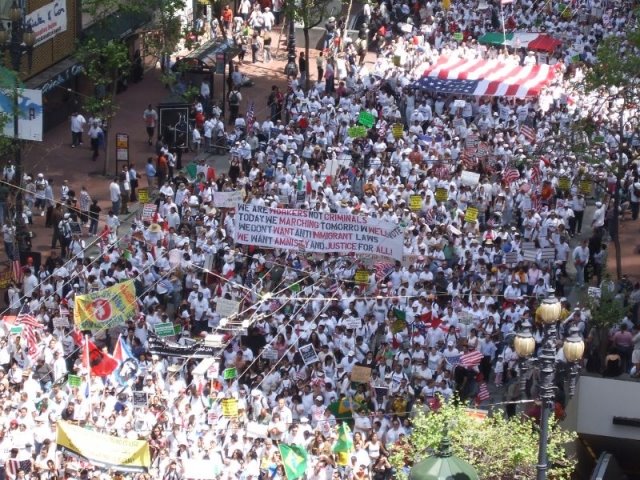
More info:
www.cirnow.org/
Go here for more detailed info and to find your senators phone numbers:
www.justiceforimmigrants.org/action.html
Please take a little time to call your senators. For real this stuff they are trying to pass it going to affect all of us. Like new ID cards with tracking devices. It doesnt take much to call and call often. Leave a message and just let them know that you support legalization and human rights...or go to one of these websites that support possitive immigration legislation to get more info on the specifics. I called yesterday. You have no idea how important it is to call. This is how our legislators make their decisions by hearing from you in the form of a fax or a phone call they count it as representing a larger voice of dissent. For reals. REAL TALK. It doesnt take much time out of your day. Here's a local number for Feinstein 415-3930-0707
ITS THE VERY LEAST YOU CAN DO and its pretty simple. abrazos, la mayita
Wednesday, May 17, 2006
Tuesday, May 16, 2006
Immigration Action
Take Action Now!
Please Contact your Senators Today Regarding S. 2611, The Comprehensive Immigration Reform Act of 2006
This week, the U.S. Senate will be considering S. 2611, the Comprehensive Immigration Reform Act (CIRA) of 2006. The legislation represents a positive step forward in enacting a comprehensive immigration reform bill before the end of the year. Over the next two weeks, the Senate will consider amendments to the legislation, both amendments which would improve the bill and those which would cause more harm to immigrants and refugees. It is important that the Catholic network weigh in on this important issue at such a critical juncture.
CIRA contains many positive provisions, including a legalization program which includes a path to citizenship for up to 10 million persons in Title VI; family unity provisions in Title V; and a temporary worker program in Title IV. However, it also contains overly punitive enforcement provisions in Title II of the bill. Moreover, it contains provisions which could preclude some of the undocumented population from qualifying for the legalization program. It is important that our elected officials receive the appropriate messages regarding this legislation. They include the following:
Legalization provisions: We support the provisions in Title VI which provide a path to citizenship for up to 10 million persons and the provisions in Titles IV (temporary worker program) and V (family-based immigration). However, we support changes in the bill to allow the maximum number of undocumented persons to qualify for a path to citizenship. These would include:
*
Restoration of protections for those persons who have resided in the country for 2-5 years and who would be required to go home prior to applying for a green card, including restoration of confidentiality in the process; a right to appeal adverse decisions; no waiver of rights, and an extension of the application deadline.
*
Creation of a realistic opportunity for those here 0-2 years to participate in the program, who under the bill must return home and apply through the temporary worker program, which could take years.
*
Removal of provisions which would render ineligible any person who commits document fraud or misrepresents fact on a I-9 application. (Undocumented immigrants without legal status often are compelled to misrepresent their status in order to obtain employment)
Enforcement Provisions: We also support amendments to the bill which would remove or ameliorate harsh enforcement provisions in Title II, including:
*
the expansion of the definition of an aggravated felony;
*
increased use of indiscriminate mandatory and indefinite detention;
*
removal of protections for asylum-seekers, refugees, and other vulnerable populations;
*
the authorization of local law enforcement to enforce federal immigration laws;
* limits on judicial review.
Please call your Senators regarding S. 2611.
Please write your Senators regarding S. 2611.
Please Contact your Senators Today Regarding S. 2611, The Comprehensive Immigration Reform Act of 2006
This week, the U.S. Senate will be considering S. 2611, the Comprehensive Immigration Reform Act (CIRA) of 2006. The legislation represents a positive step forward in enacting a comprehensive immigration reform bill before the end of the year. Over the next two weeks, the Senate will consider amendments to the legislation, both amendments which would improve the bill and those which would cause more harm to immigrants and refugees. It is important that the Catholic network weigh in on this important issue at such a critical juncture.
CIRA contains many positive provisions, including a legalization program which includes a path to citizenship for up to 10 million persons in Title VI; family unity provisions in Title V; and a temporary worker program in Title IV. However, it also contains overly punitive enforcement provisions in Title II of the bill. Moreover, it contains provisions which could preclude some of the undocumented population from qualifying for the legalization program. It is important that our elected officials receive the appropriate messages regarding this legislation. They include the following:
Legalization provisions: We support the provisions in Title VI which provide a path to citizenship for up to 10 million persons and the provisions in Titles IV (temporary worker program) and V (family-based immigration). However, we support changes in the bill to allow the maximum number of undocumented persons to qualify for a path to citizenship. These would include:
*
Restoration of protections for those persons who have resided in the country for 2-5 years and who would be required to go home prior to applying for a green card, including restoration of confidentiality in the process; a right to appeal adverse decisions; no waiver of rights, and an extension of the application deadline.
*
Creation of a realistic opportunity for those here 0-2 years to participate in the program, who under the bill must return home and apply through the temporary worker program, which could take years.
*
Removal of provisions which would render ineligible any person who commits document fraud or misrepresents fact on a I-9 application. (Undocumented immigrants without legal status often are compelled to misrepresent their status in order to obtain employment)
Enforcement Provisions: We also support amendments to the bill which would remove or ameliorate harsh enforcement provisions in Title II, including:
*
the expansion of the definition of an aggravated felony;
*
increased use of indiscriminate mandatory and indefinite detention;
*
removal of protections for asylum-seekers, refugees, and other vulnerable populations;
*
the authorization of local law enforcement to enforce federal immigration laws;
* limits on judicial review.
Please call your Senators regarding S. 2611.
Please write your Senators regarding S. 2611.
Monday, May 15, 2006
Central America and Iraq
Grandin on Rumsfeld's Latin American Wild West Show( click on the link above to read more)
It was in Central America, remember, that President Ronald Reagan first actively faced off against the "Evil Empire." It was through Central American policy that the previously distinct strands of conservatism and neoconservatism first broke foreign bread (and foreign heads) together. It was the anvil upon which the ideas and constituencies that drive Bush's aggressive foreign policy today were first hammered out. It was the place that secular neocons and anti-communist militarists came together with the Christian New Right to oppose Catholicism's Liberation Theology, which, for them, was the radical Islam of its moment -- at a time when Reagan's CIA director was playing footsy in Afghanistan and elsewhere with the Islamic jihadists who would later be melded with the "axis of evil" into the War on Terror.
Central America was also where Republicans first embraced the idealist language of spreading "democracy" abroad as a key justification for an aggressive, violent, preemptive foreign policy. It was in relation to Central America that, through the Office of Public Diplomacy, the executive branch first used a full range of PR "perception management" techniques to sell a war -- again anticipating the media manipulation that led to the invasion of Iraq. Finally, it was in what became the Iran-Contra scandal that Republicans first tried to bypass many of the restrictions on the presidency put into place (however feebly) after Vietnam and Watergate, foreshadowing the vast, half-secret expansion of executive powers in the last five years. Not for nothing did so many of the current administration's officials and hangers on -- John Negroponte, Elliot Abrams, Otto Reich, Donald Kagan, Michael Ledeen, even John Bolton -- come out of Central America. It is a story that must be read, as must Grandin's piece on U.S. war-planning in recalcitrant Latin America.
Subscribe to:
Posts (Atom)



